Every business, regardless of size or industry, operates within an environment of uncertainty. Market conditions
shift, competitors emerge, supply chains experience disruptions, regulations change, and technological advances
reshape entire industries. Risk management — the systematic process of identifying, assessing, and responding to
these uncertainties — provides the framework through which businesses can navigate volatility while protecting their
assets, reputation, and long-term viability.
Effective risk management doesn’t aim to eliminate all risk. Taking calculated risks is fundamental to business
growth and innovation. Instead, it develops the organizational capacity to understand which risks are worth taking,
which should be mitigated, and which should be avoided entirely. Business owners who develop this capability make
better strategic decisions, respond more effectively to crises, and build more resilient organizations capable of
thriving through adversity.
⚠️ Disclaimer: This article provides general educational information about risk
management concepts. It is NOT professional risk management, financial, legal, or insurance
advice. Businesses should consult qualified risk management professionals, insurers, and legal advisors for
their specific risk assessment needs.
This educational guide explores the key principles of business risk management, from foundational concepts through
practical frameworks that business owners can adapt to their specific circumstances. Understanding these principles
provides a starting point for developing a risk-aware culture and more structured approach to managing business
uncertainty.
Types of Business Risks
Understanding the landscape of potential risks begins with categorization. While every business faces a unique risk
profile, most risks fall into several broad categories that provide a useful starting framework for identification
and assessment. Recognizing these categories helps ensure that risk assessment exercises are comprehensive rather
than focused narrowly on the most obvious or recent threats.
Strategic Risks
Strategic risks arise from fundamental changes in the business environment that may threaten the viability of a
company’s business model or competitive position. These include shifts in consumer preferences, emergence of
disruptive technologies, entry of new competitors, changes in regulatory frameworks, and macroeconomic trends that
affect demand for products or services. Strategic risks are typically the most difficult to predict and potentially
the most impactful, as they can affect the entire foundation of a business rather than specific operational
elements.
Consider how the transition to digital media created strategic risk for traditional print publishers, or how
ride-sharing platforms disrupted the taxi industry. These transformations didn’t happen overnight, and businesses
that maintained awareness of emerging trends and developed adaptive strategies were better positioned to respond.
Strategic risk management requires continuous environmental scanning and willingness to challenge assumptions about
what will continue to work in the future.
Operational Risks
Operational risks stem from internal processes, systems, people, or external events that can disrupt business
operations. These include equipment failures, supply chain disruptions, key employee departures, quality control
failures, workplace safety incidents, and IT system outages. While individual operational risks may seem manageable,
their cumulative impact on business performance can be significant, and cascading failures — where one operational
problem triggers others — can create crises that exceed the apparent magnitude of the initial event.
Financial Risks
Financial risks relate to a business’s financial structure and exposures. These encompass cash flow variability,
credit risk from customers who may not pay, interest rate changes affecting borrowing costs, foreign currency
fluctuations for international businesses, and commodity price volatility for businesses dependent on raw materials.
Financial risks often interact with operational and strategic risks, amplifying their impact when financial reserves
are insufficient to absorb unexpected costs or revenue shortfalls.
Compliance and Legal Risks
Regulatory compliance requirements vary by industry and jurisdiction but affect virtually every business. Failure to
comply with employment laws, tax regulations, environmental requirements, data privacy standards, or
industry-specific regulations can result in fines, legal liability, reputational damage, and in extreme cases,
business closure. The compliance risk landscape has grown increasingly complex as regulations proliferate and
enforcement mechanisms strengthen.
| Risk Category | Examples | Typical Impact | Monitoring Approach |
|---|---|---|---|
| Strategic | Market disruption, new competitors, changing regulations |
Potentially existential — affects entire business model |
Environmental scanning, scenario planning |
| Operational | Supply chain failures, key person departure, IT outage | Disrupts daily operations and customer service | Process monitoring, incident tracking |
| Financial | Cash flow gaps, bad debts, interest rate changes | Affects liquidity, profitability, and solvency | Financial reporting, cash flow forecasting |
| Compliance | Tax violations, employment law breaches, data privacy | Fines, legal liability, reputational damage | Compliance audits, regulatory tracking |
| Reputational | Negative publicity, product recalls, social media crises |
Loss of customer trust and brand value | Brand monitoring, customer feedback |
The Risk Management Process
Structured risk management follows a cyclical process of identification, assessment, response planning,
implementation, and monitoring. This process creates a systematic approach that helps ensure important risks aren’t
overlooked and that management responses are proportionate to the threats they address. While the specifics vary by
organization, the underlying logic remains consistent across business sizes and industries.
Risk Identification
The first step involves systematically cataloging the risks that could affect your business. Multiple identification
techniques improve comprehensiveness: brainstorming sessions with team members who bring different perspectives,
review of industry reports identifying common risks in your sector, analysis of past incidents and near-misses,
examination of competitor experiences, and structured checklists that prompt consideration of risk categories you
might otherwise overlook.
Effective risk identification casts a wide net initially, then progressively focuses attention on the most relevant
threats. Include internal risks — arising from your own operations, people, and systems — and external risks —
arising from market conditions, competitors, regulations, natural events, and broader economic forces. The goal at
this stage is completeness rather than precision; risks can be evaluated and prioritized in subsequent steps.
Risk Assessment and Prioritization
Not all identified risks warrant equal attention. Risk assessment evaluates each risk on two dimensions: the
likelihood that the risk event will occur, and the impact it would have if it did occur. The product of likelihood
and impact provides a rough prioritization that helps focus management attention on the most significant threats.
Risks that are both highly likely and highly impactful demand immediate attention, while risks that are unlikely and
low-impact may be accepted without significant mitigation effort.
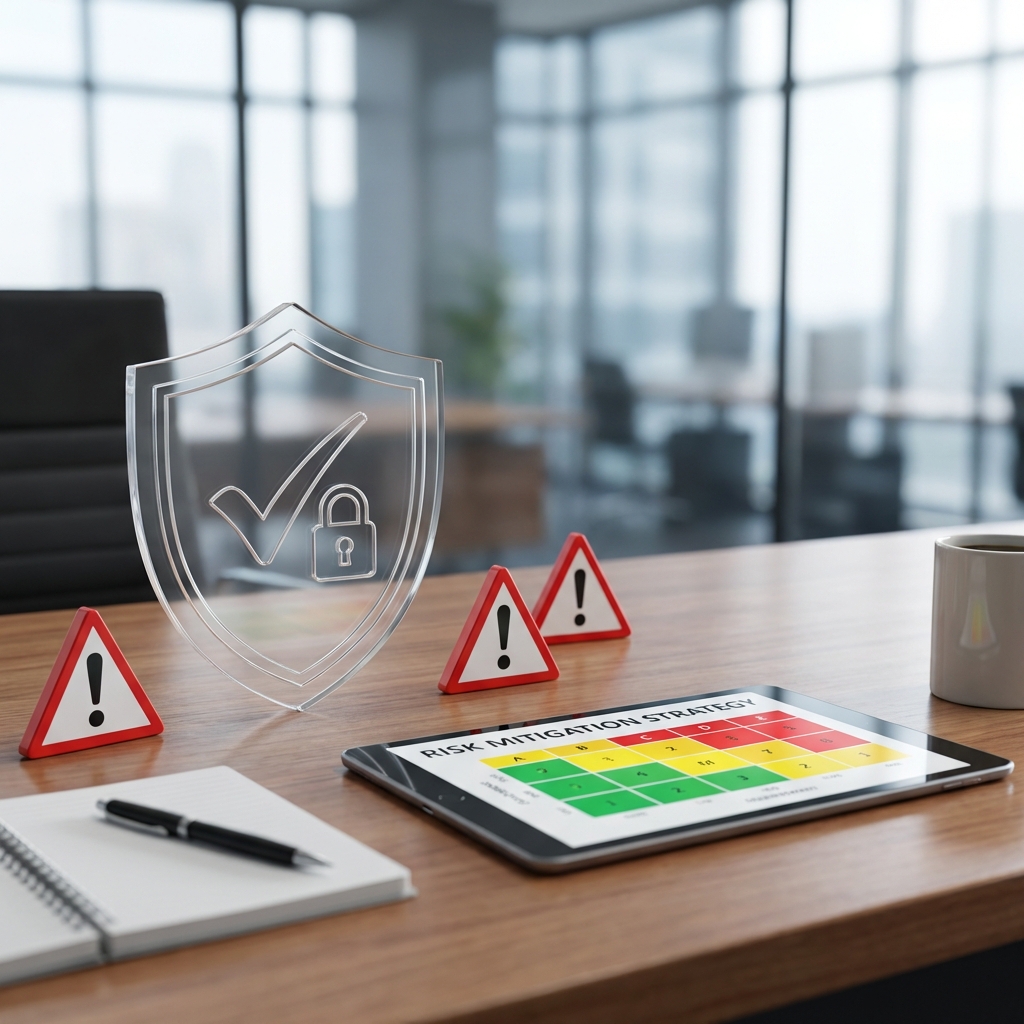
A risk assessment matrix provides a visual framework for this prioritization. Plotting risks on a grid with
likelihood on one axis and impact on the other creates a clear picture of the risk landscape and helps identify
which risks fall into different management categories. This visual tool is particularly useful for communicating
risk priorities to team members and stakeholders who may not be involved in the detailed assessment process.
Risk Response Strategies
For each significant risk, business managers generally choose among four fundamental response strategies. Risk
avoidance involves changing plans or processes to eliminate the risk entirely — for example, deciding not to enter a
market with unacceptable regulatory uncertainty. Risk mitigation involves taking actions to reduce the likelihood or
impact of the risk — such as installing backup power systems to mitigate the risk of power outages disrupting
operations.
Risk transfer involves shifting the financial impact of a risk to another party — most commonly through insurance
policies, but also through contracts, partnerships, or outsourcing arrangements. Risk acceptance involves
acknowledging the risk and deciding that the cost of mitigation exceeds the expected cost of the risk materializing.
Accepted risks should still be monitored, and contingency plans developed for those with potentially significant
impacts.
Building a Risk-Aware Culture
The most sophisticated risk management frameworks fail when the organizational culture doesn’t support them. A
risk-aware culture — one where team members at all levels feel empowered to identify and escalate risks, where
near-misses are treated as learning opportunities rather than embarrassments, and where risk considerations are
integrated into daily decision-making — provides the foundation for effective risk management.
Leadership’s Role in Risk Culture
Leaders set the tone for risk culture through their behavior and priorities. When leaders consistently ask about
risks during project planning, celebrate early identification of potential problems, respond to bad news
constructively rather than punitively, and demonstrate balanced risk-taking in their own decisions, they create
norms that encourage risk awareness throughout the organization. Conversely, leaders who penalize messengers of bad
news, dismiss risk concerns as negativity, or demonstrate reckless risk-taking undermine risk management regardless
of the formal policies in place.
Integrating Risk Thinking into Daily Operations
Risk management should not be a periodic exercise conducted annually and then forgotten. Integrating risk
considerations into regular business processes — project planning, supplier selection, customer onboarding,
strategic planning, and operational reviews — makes risk management a natural part of how the business operates
rather than a separate administrative burden. Simple practices like including “risk considerations” as a standing
agenda item in management meetings, requiring risk assessments for projects above certain thresholds, and
maintaining a visible risk register that’s updated regularly can embed risk awareness into organizational routines.
Practical Risk Mitigation Strategies for Common Business Risks
While theoretical frameworks provide structure, practical mitigation strategies address the specific risks that
businesses encounter most frequently. The following approaches represent common strategies that businesses of
various sizes implement to manage their most prevalent risk exposures.
Key Person Risk
Many small businesses are heavily dependent on one or a few individuals whose departure, illness, or incapacitation
could severely impact operations. Mitigating key person risk involves documenting critical processes so others can
step in, cross-training team members on essential functions, developing succession plans for critical roles, and
considering key person insurance for individuals whose absence would create significant financial impact.
Customer Concentration Risk
Businesses that derive a large percentage of revenue from a small number of customers face concentration risk — the
potential for significant revenue loss if one major customer leaves. Mitigation strategies include actively
diversifying the customer base, deepening relationships with existing customers to increase loyalty, building
contractual protections where possible, and developing contingency plans that address how the business would respond
to the sudden loss of its largest customers.
Supply Chain Risk
Supply chain disruptions can halt operations for businesses that depend on specific suppliers, components, or
materials. Building resilience involves identifying alternative suppliers for critical inputs, maintaining strategic
inventory buffers for essential materials, developing relationships with backup suppliers before they’re needed, and
monitoring supplier financial health to anticipate potential problems before they affect your supply chain.
Cybersecurity Risk
As businesses become increasingly digital, cybersecurity risks escalate. Data breaches, ransomware attacks, and
system compromises can result in financial losses, regulatory penalties, and reputational damage. Basic
cybersecurity hygiene — strong password policies, regular software updates, employee security awareness training,
data backup procedures, and appropriate access controls — addresses many common vulnerabilities. Businesses handling
sensitive data should consider engaging cybersecurity professionals to assess their specific risk profile and
recommend proportionate protections.
Business Continuity Planning
Business continuity planning extends risk management by developing detailed plans for maintaining critical business
functions during and after disruptive events. While risk management focuses on preventing adverse events, business
continuity planning acknowledges that some events cannot be prevented and focuses on maintaining operations through
them. A business continuity plan identifies critical business functions, establishes recovery priorities, documents
step-by-step procedures for various disruption scenarios, and defines roles and responsibilities during crisis
response.
Elements of an Effective Business Continuity Plan
An effective plan includes a business impact analysis that identifies which functions are most critical and how
quickly they must be restored, recovery strategies for different types of disruptions, communication plans for
notifying employees, customers, and stakeholders, and regular testing and exercises to ensure the plan works in
practice. The plan should be documented, accessible to relevant team members, and updated regularly to reflect
changes in business operations, personnel, and external conditions.
Monitoring and Review
Risk management is a continuous process, not a one-time exercise. The risk landscape evolves constantly as market
conditions change, new threats emerge, and previous risks materialize or dissipate. Regular review cycles —
quarterly for most businesses, with more frequent reviews during periods of significant change — ensure that risk
assessments remain current and management responses remain appropriate.
Key Risk Indicators
Key Risk Indicators (KRIs) are quantitative or qualitative measures that provide early warning signals about
increasing risk exposure. For example, rising customer complaint rates might indicate emerging product quality
risks, increasing staff turnover might signal organizational culture risks, or declining cash reserves might flag
financial vulnerability. Identifying and monitoring appropriate KRIs for your most significant risks enables
proactive management rather than reactive crisis response.
Conclusion
Risk management is not about building walls against every conceivable threat — it’s about developing the
organizational awareness, analytical capability, and response readiness to navigate uncertainty intelligently.
Business owners who invest in understanding their risk landscape, developing proportionate mitigation strategies,
and building risk-aware cultures create organizations that are both more resilient and more capable of seizing
opportunities that inherently involve risk.
Begin with the fundamentals: identify your most significant risks, assess their likelihood and potential impact,
develop response strategies for the highest-priority threats, and embed risk thinking into your regular management
processes. As this capability matures, it becomes a strategic asset that supports better decision-making, stronger
stakeholder confidence, and more sustainable business success.
Remember that effective risk management is proportionate to your business’s size, complexity, and risk exposure. A
small business doesn’t need the elaborate risk management infrastructure of a multinational corporation, but it does
need systematic thinking about the threats and opportunities that could materially affect its future. The investment
in developing this capability pays dividends through avoided losses, faster recovery from setbacks, and greater
confidence in strategic decision-making.
For related educational content, explore our guides on business
financial planning and budgeting and strategic planning
frameworks for SMBs.
Important: This information is provided for educational purposes only. We are not financial
advisors, and this content should not be considered professional financial advice. Always consult with qualified
professionals regarding your specific business situation.